Getting your license
Ever wonder why there are so many #realtors in the #GTA? In case you did not realize it there are 50,000 realtors working with the #Toronto #Real Estate Board (#TREB). More alarming still is that there are only 50,000 Realtors working outside of #Ontario in the other 9 provinces and territories put together. In Canada (as per the Canadian Real Estate Association – CREA), there are a total of 120,000 realtors. The Ontario Real Estate Association (#OREA) claims 70,000 members total (thus accounting for the 50,000 outside of Ontario). Going by that per capita rate, you would expect the Toronto Census Metropolitan Area (CMA) with its population of 6.4 million would have about 20,000 or so realtors. But the current 50,000 realtors working with TREB means the Toronto CMA has 17% of Canada’s population but 41% of the Realtors.

That’s a crazy stat isn’t it? Ever wonder why that is?
There are many factors to why the Toronto CMA does indeed have an unbalance in number of realtors and a lot of it can be easily attributed to:
- the price of houses in the GTA is one of the highest in the country, thus the commission cheques are good
- real estate brokerages profit like mad from having more realtor #salespeople on their staff
- there is an incredibly low barrier to entry into the real estate profession
Here, we’ll discuss how it got to this and inform you of how easy it is for you realtor to NOT BE GOOD at all due to the manner in which they are trained.
What it used to be like
#Education requirements, I must admit, have come a long way. When I first started in realty, the rules were even less stringent and in every single one of my courses, I saw so many people that I would never hire for any business at all, much less one in which a consumer would entrust their biggest transaction, that it led me to believe that this was a flawed system, a system geared specifically to solely make money for the governing bodies.
At that time, I had to pass a mere three (3) exams and then go through an “#articling” period (that lasted two (2) years) during which I needed to take three (3) more courses.
Total time spent in class and writing exams: 160 hours
That’s right, in less than one month worth of regular working hours, I was able to help you buy or sell your home.

Since then, the rules have changed (very recently) to required that ALL of the five (5) courses be taken prior to actual registration (a period called #pre-registration), which means that candidates now must make the effort to take approximately 240 hours of total class and exam time.
There is of course the option to do all this through correspondence, through other prep courses or by using the fabulous study tools sanctioned by the governing body – Pass-It, which basically gives a student access to every single question and answer you might face on a final exam.
Here is a quick overview of the changes as they occurred for realtor #licensing in Ontario:
- 1950s – OAREB makes education courses available and basic examinations for registration become law
- 1960s – To become a member of any of Ontario’s 42 real estate boards, prospective salespeople must attend 16 lectures and pass a 2½ hour examination.
- Mandatory education is established
- 1970s – OAREB’s mandatory registration education program is extended to include 150 hours of course study
- 1980s – Mandatory articling is introduced and members are required to complete #continuing education within the first two years after registration
- 2000s – Mandatory continuing education for salespeople and brokers becomes law
- 2016 – Minimum requirement of five (5) pre-registration courses with only one (1) articling elective
Admission Requirements
To apply to the pre-registration phase, you must either:
Have an Ontario Secondary School Diploma or equivalent OR be at least 18 years of age and pass a qualifying test approved by the Superintendent of Private Career Colleges, Ministry of Training, Colleges and Universities.
Your realtor might just be a high-school dropout!

/GettyImages-488310447-5770678c3df78cb62cb302bc.jpg)
Passing grades
I believe that one of the way that they try to justify the apparent difficulty of this registration is to set a false high bar for passing grades. The minimum grade to pass any of the courses is a 75%, which is indeed a high grade. Luckily (for aspiring salespeople – and unluckily for the public) with all the tools available to help guide the study; you have to actively try to not pass these exams.

Prep courses are everywhere
In order to help all these realtors in training, tons of businesses have popped up all over Ontario to prep the salespeople for tests. Many of them actually guarantee a pass or your money back.



Pass-it tests
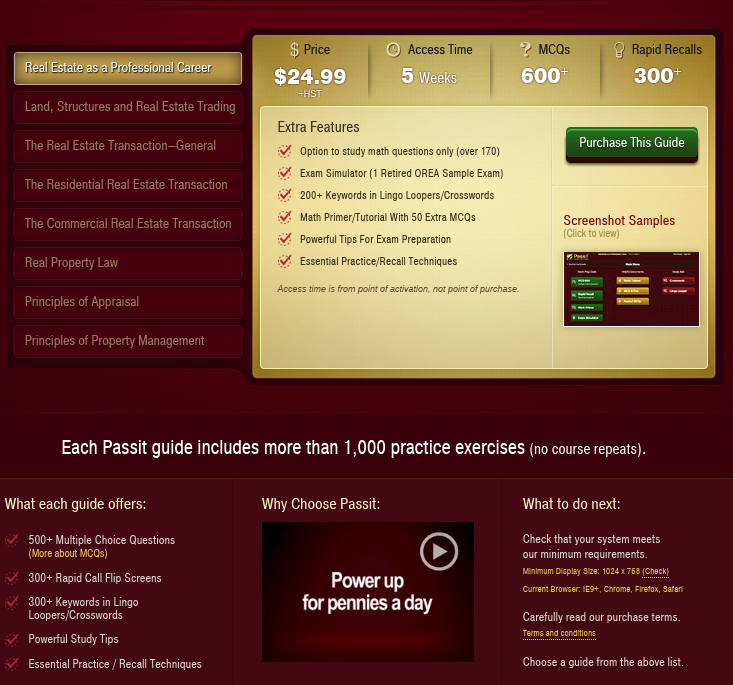
Then there is the OREA endorsed study program called Pass-It. You would think that if an organization was truly out to help consumers (and not its constituents – the realtors) by testing and ensuring good quality of realtors were serving consumers, it would not basically have realtors pay a mere $25 for access to each courses’ crypt sheet (more or less).
Actually becoming a realtor
So here is the requirements for becoming a realtor as of April 2016.
Part I: PRE-REGISTRATION Segment
As of April 2016, 5 courses are compulsory and must be passed (at the 75% mark) within 18 months from the date of registration.
- COURSE 1 – Real Estate as a Professional Career
- COURSE 2 – Land, Structures and Real Estate Trading
- COURSE 3 – GENERAL – The Real Estate Transaction
- COURSE 3 – RESIDENTIAL – Residential Real Estate Transaction
- COURSE 4 – COMMERCIAL – Commercial Real Estate Transaction
- REAL PROPERTY LAW
Part II: ARTICLING Segment
A two-year Articling Segment during which you complete the requirements for renewal of your registration as a #salesperson by choosing any ONE of these elective courses:
- Principles of Appraisal
- Principles of Mortgage Financing
- Principles of Property Management
- Real Estate Investment Analysis
Continuing education
Once you are a real estate salesperson (and beyond the articling period), there are continuing education requirements that must be met. Over a period of 24 months, each registrant must complete a Residential Update Course or Commercial Update Course, plus their choice of two elective courses.

What it looks like in practice
In practice, these courses are completely self-driven and require much less effort than one might think. In the past, you at least had to attend some class(es) at your local real estate board, but these days with everything being online, it’s all just a matter of a few clicks away. With all of it being self-driven, multiple choice, all you need to do these days is let the audio play and then click a few questions (which you can go back to in order to answer correctly if you happen to not do so on your first try). Further, most realtors I know do not take this seriously and do one of two things:
- complete these courses at the last minute possible (i.e. at the 23rd month)
- get their admin staff to do it for them
In either case, the intent of these courses and the continuing education on the whole is marginalized and the needs of consumers is put on the back burner.
What brokerages ask of you
Are the employers of these realtors doing better than the governing body? The short answer is NO. There really isn’t any serious thought to enforcing further education, especially because the business model for brokerages is to hire realtors as independent contractors who can leave at any time; so trying to enforce anything breaks your line of revenue as a brokerage. I have seen some brokerages that do host a bunch of new realtor training courses, however once you are beyond the honeymoon phase, almost no realtor bothers taking any other courses.
What we (iListMLS) asks of our realtor salespeople
At iListMLS we care deeply about our clients and as such, we only hire the very top of the top and empower them with the best tools and staff in the business. This does not come at a cheap cost to us, but investing in our people (and in your service) is the reason why we are so good. Our founder has been a mentor, coach and teacher all his life and believes in growing his staff with compulsory training.

Our multi-week FORWARD (Focus On Realtors Who Are Ridiculously Dedicated) program pairs our newly hired salespeople with experienced agents and walks them through real-world situations, such as sales calls and closings. New agents learn marketing techniques and how to position themselves as real estate experts in their local communities. They are divided into groups of 10 agents and expected to hold each other accountable for meeting personal expectations.
Step 2 of our operation is to empower our real estate salespeople to use our #Artificial Intelligence tools to make better decisions, show better houses and ensure the clients (and customers) are being served better than any other real estate brokerage would.
Our training philosophy centers around seeing potential clients as people first and customers second. This mindset teaches and enables agents to connect with people on a more personal level and gain a deeper understanding of their needs and wants. The added tools we provide as a brokerage (the Artificial Intelligence) then kick this into overdrive and ensure our staff is serving clients at a level that is acceptable to our very stringent process and agent measurement.
The average agent who completes the FORWARD program closes ten times the deals per year of other realtors in Toronto and more in commissions than over 50% of the average real estate agents nationwide.